
Universal Commerce Protocol (UCP): What It Is, How It Works, and Why It Matters for Businesses in 2026
26 min read
13 July 2026
By Aijaz Mughal
Google’s Universe Commerce Protocol (UCP) is an open standard designed with the objective of turning meaningful AI interactions into instant sales. Developed by Google, Shopify, Walmart, and Etsy Universe Commerce Protocol (UCP) addresses two core issues faced by online sellers. First, is the reduction of the friction at the product checkout, and second is elimination of the need for independent one-to-one interaction between retailer, AI agents, and eCommerce platforms.
Universal Commerce Protocol (UCP) has introduced a standardized communication framework, enabling all participants to connect seamlessly, while eliminating development complexity, enhancing interoperability, and making AI-powered commerce highly scalable.
Universal Commerce Protocol (UCP) is set to revolutionize online shopping experiences, as conversational AI agents like Gemini can not only recommend products based on customer’s queries or requirements, but can also handle and execute the overall transaction product from initial product selection to final purchase, on behalf of the user. Universal Commerce Protocol (UCP) is set to redefine shopping, so without further ado, let’s explore what UCP is, how it works, and why it matters for eCommerce businesses in 2026.
What is the Universal Commerce Protocol (UCP)?
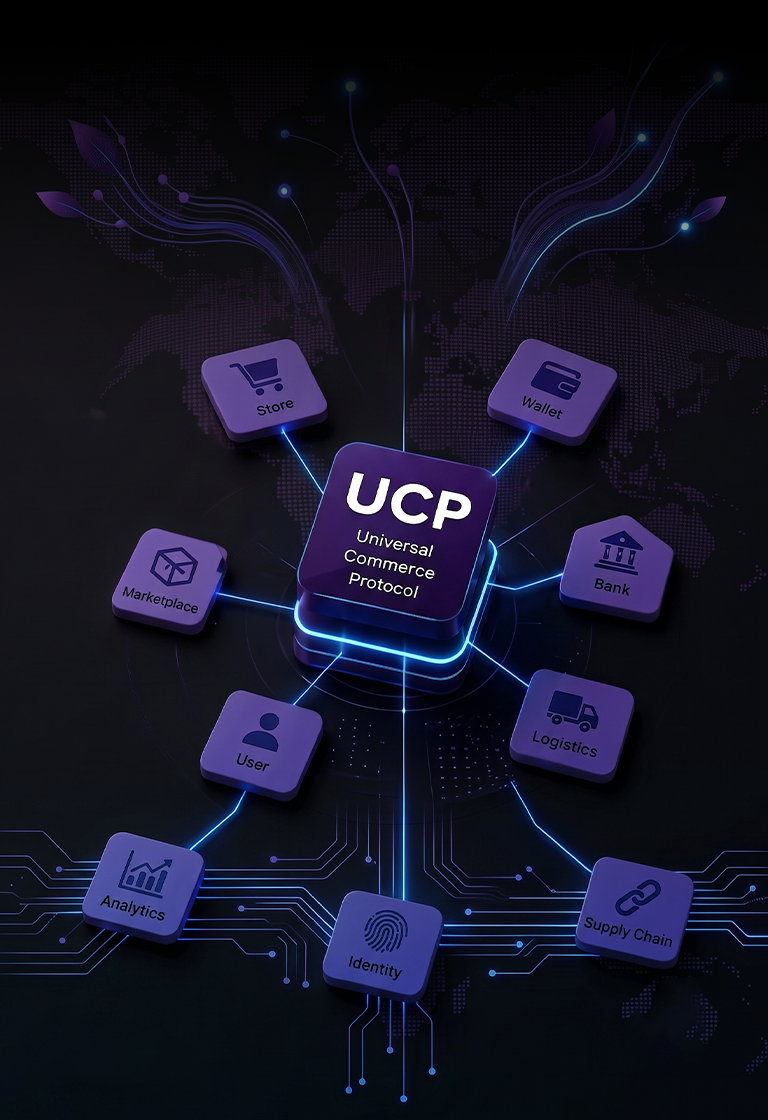
Universal Commerce Protocol (UCP) is an open-source commerce standard that allows a common language among AI agents, retailers, along with payment providers. Like internet protocols that link websites with devices, UCP is dedicated to commerce functions like product discovery, checkout, order management, as well as payments.

Prior to UCP, each AI shopping assistant had to be integrated with specific retailers. This added complexity in the context of the growing number of AI-powered shopping platforms. With UCP, businesses have one integration that can be used within multiple AI agents and commerce platforms.
Google announced UCP as an open source project to promote broad industry usage and prevent vendor lock-in. The protocol is now supported by major retailers, payment providers, and e-commerce platforms, such as Shopify, Stripe, MasterCard, Visa, Walmart, and Target.
How UCP Works
UCP provides standardized APIs together with communication layers to assist AI systems in communicating directly with retailers in real-time. AI agents can automatically navigate through product catalogs, compare prices, and check stock availability, while getting full product details in seconds, removing the need for users to browse websites manually. The protocol also allows agents to add items to shopping carts, adjust quantities, add discounts, compute taxes, and perform other features like choosing shipping options without manual intervention.

All retailers communicate in the same format, so AI assistants can operate on many platforms without having to integrate with each retailer. This results in a quicker plus smoother shopping journey, allowing for purchases to be made directly within the AI conversations. It also streamlines checkout processes while at the same time improving accessibility in AI-powered commerce systems for businesses.
What are the Core Capabilities of Universal Commerce Protocol (UCP)
The core capabilities or the distinctive features that Universal Commerce Protocol (UCP) offers to retailers are:
|
Capability |
Description |
Product Discovery
|
AI agents have the ability to directly access retailers' up-to-date product catalogs, stock levels, pricing, specifications, and variants. |
Cart Management
|
Agents can add several products to carts, update quantities, add discounts, and calculate totals before checkout. |
Checkout
|
It handles secure checkout flows, payment methods, taxes, shipping calculations, and checkout confirmation. |
Identity Linking
|
Retailers can link their accounts with AI assistants to unlock loyalty benefits, member pricing, and custom experiences for their customers. |
Order Management
|
Once orders are placed, AI assistants can monitor them, verify delivery status, and handle returns and exchanges. |
What is the Technical Architecture of UCP
UCP is compatible with several ways of communication, which work across platforms and systems.
REST APIs
Retailers can use standard HTTP APIs and JSON data to integrate existing commerce systems.
Model Context Protocol (MCP)
This allows AI models to directly engage with commerce systems in conversations and decision-making.
Agent-to-Agent Communication
AI agents can work together to perform various tasks, such as one agent researching products and another agent assisting with checkout.
The flexible architecture assists small businesses and large enterprises in deploying UCP as per their technical expertise.
How UCP Enables Secure AI-Powered Transactions
UCP works with secure payment systems via the Agent Payments Protocol (AP2). User authorization is required before making a purchase.
The protocol also supports existing payment providers like Google Pay and PayPal, which makes it easier for businesses to leverage familiar payment systems without having to change their existing infrastructure.
Retailers are still the seller of record, importantly. Customer relationship, order data and post-purchase communication still belong to businesses. UCP only allows the transaction process between AI agents and retailers.
Why UCP Matters for Businesses
Growth of AI-Driven Shopping
Consumers are increasingly moving towards conversational and AI-driven shopping. Users are more likely to rely on AI assistants to search for and make purchases on their behalf, rather than manually navigating websites.
This is changing the game of online business competition. In the past, the emphasis in e-commerce was on website design and user navigation. UCP redefines structured product data, machine-readable catalogs, and AI accessibility.
Without UCP support, businesses could be less visible when using AI shopping.
Higher Purchase Intent
When users are already in the mindset of purchasing, they are likely to engage in AI-assisted shopping. Searches like “buy running shoes for under $100” are typically not exploratory but rather indicate a clear desire to purchase.
Retailers can be part of these AI-powered purchase conversations without friction between discovery and checkout by integrating with UCP.
Lower Cart Abandonment
The traditional checkout process consists of several steps, and it's common for people to leave carts behind. UCP streamlines the checkout process by automatically loading payment information, shipping preferences, and account details from a saved profile for AI agents. This smoother process can help to increase conversion rates and minimize lost sales.
Better Customer Retention
AI assistants can streamline repeat purchases, potentially leading to improved repeat buying rates for businesses. Customers can make simple requests via conversation without having to go back to websites.
How Leading eCommerce Companies are Embracing UCP
A number of leading ecommerce companies are already supporting UCP.
Shopify and Woo Commerce
Easier UCP integrations are expected on these platforms, via built-in updates and plugins.
Enterprise Platforms
For larger companies that are already on Salesforce, Stripe, or their own infrastructure, UCP can be implemented via API or SDK.
Hybrid Adoption
UCP may be initially allowed for certain product categories or customers before being extended.
How to Optimize Data for UCP?
As commerce increasingly moves into the realm of AI, the importance of strong product data grows.
Businesses should improve:
- Product specifications
- Structured attributes
- Inventory accuracy
- Compatibility details
- Product descriptions
AI agents need accurate, structured information to make the right product recommendation. Bad product data can diminish visibility in conversational shopping.
Google has also added conversational commerce attributes to Merchant Center to make AI product discovery and recommendations better.
Challenges of UCP Adoption
While UCP has significant advantages, there can be hurdles to implementation for businesses.
Technical Integration
Smaller retailers might need assistance developing systems to meet UCP standards.
Data Quality Requirements
If product data is incomplete or inconsistent, then there is a need for major changes in the catalog.
Rapid Ecosystem Changes
AI commerce is rapidly changing, and retailers need to stay up to date with new standards, features, and customer shopping habits. All this can be overcome, and early adoption can offer long-term competitive benefits.
UCP the Future of Agentic Commerce
UCP is a significant advancement in the direction of agentic commerce, which involves AI assistants managing a significant part of the shopping process automatically. Users are likely to increasingly turn to AI conversations to find and purchase products rather than visiting websites directly.

This shift alters the way businesses think about visibility, optimization, and customer engagement. Structured data, AI-friendliness, and smooth integrations are as crucial as conventional website experiences.
UCP could become an infrastructure standard for e-commerce, as more platforms, payment providers, and retailers begin to support it.
Final Words
Despite its various benefits, the emergence of agentic commerce protocols like the UCP and ACP raises a familiar challenge for enterprises: the ability to support multiple integration standards while maintaining a single, consistent commerce infrastructure. Enterprises with clean APIs built into their websites for supporting eCommerce operations will have an edge, as they will possess the ability of exposing them via UCP, ACP, or any other agentic commerce protocol.
This further reinforces the significance of partnering with a reliable web design company that understands API-first architecture, headless commerce, and structured data implementation that can seamlessly adapt to emerging AI-driven shopping experiences. Through investing in a flexible, integration-ready website capable of supporting agentic commerce protocols, businesses can stay one step ahead of their competitors as conversational commerce is set to become the next frontier of online retail.
FAQs
Q1. What is the Universal Commerce Protocol (UCP)?
UCP is an open-source commerce standard that allows AI assistants to interact with online stores. It helps automate product discovery, checkout, and order management.
Q2. Why is UCP important in 2026?
UCP supports the growing shift toward AI-driven shopping experiences. It allows businesses to become visible in conversational and agentic commerce platforms.
Q3. How does UCP work?
UCP connects retailers, AI agents, and payment systems through standardized APIs. This allows AI assistants to complete purchases on behalf of users.
Q4. Which companies support UCP?
Major companies like Google, Shopify, Walmart, Stripe, Visa, and Mastercard are supporting or integrating UCP into their systems.
Q5. Can small businesses use UCP?
Yes, small businesses can adopt UCP through e-commerce platforms and plugins. Many integrations are expected to become easier in 2026.
Q6. Does UCP replace existing payment systems?
No, UCP works alongside existing payment providers like Google Pay and PayPal. It simply improves how transactions are handled through AI agents.
Q7. Is UCP secure for online payments?
Yes, UCP uses secure authorization systems and encrypted communication. User approval is still required before completing transactions.
Q8. How does UCP reduce cart abandonment?
AI agents can automate checkout using saved payment and shipping details. This removes extra steps that often cause users to leave carts unfinished.
Q9. What kind of businesses benefit most from UCP?
E-commerce stores, retailers, and brands with strong online sales strategies can benefit the most. Businesses with structured product data gain better visibility.
Q10. Will UCP become common in future e-commerce?
UCP is expected to grow as AI shopping becomes more popular. Many experts see it as a major part of the future commerce infrastructure.
Author
Aijaz Mughal is a digital marketing strategist, business growth advisor and Founder & Managing Director of Aun Digital. With more than 15 years of experience in the UAE market, he has worked across SEO, PPC, performance marketing, digital strategy, social media, project management and team leadership.Throughout his career, Aijaz has worked with leading brands including Emaar, Masdar, Honda, Leejam, Unilever, The Dubai Mall, Emerson, Moorfields and Yamaha, helping businesses develop effective digital strategies and achieve measurable growth.
Speak to an Expert